Sculpture · Species study · 2026
Aeolian Harp
Translating Chickadee acoustic research into a wind-driven physical instrument.
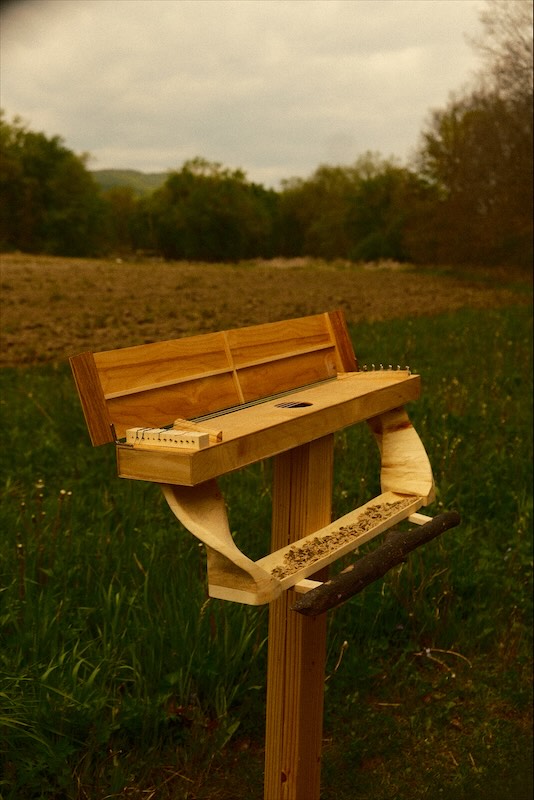
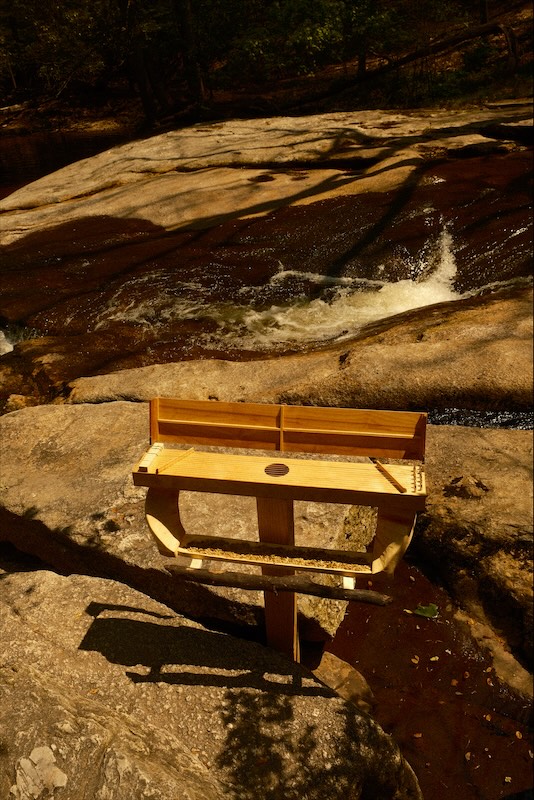
A wind-played harp and bird feeder, built and installed outdoors as one sculpture, recorded in the field, then reconstructed digitally.
- Research
- Translation
- Fabrication
- Installation
- Recording
- Reconstruction
01
Built by hand
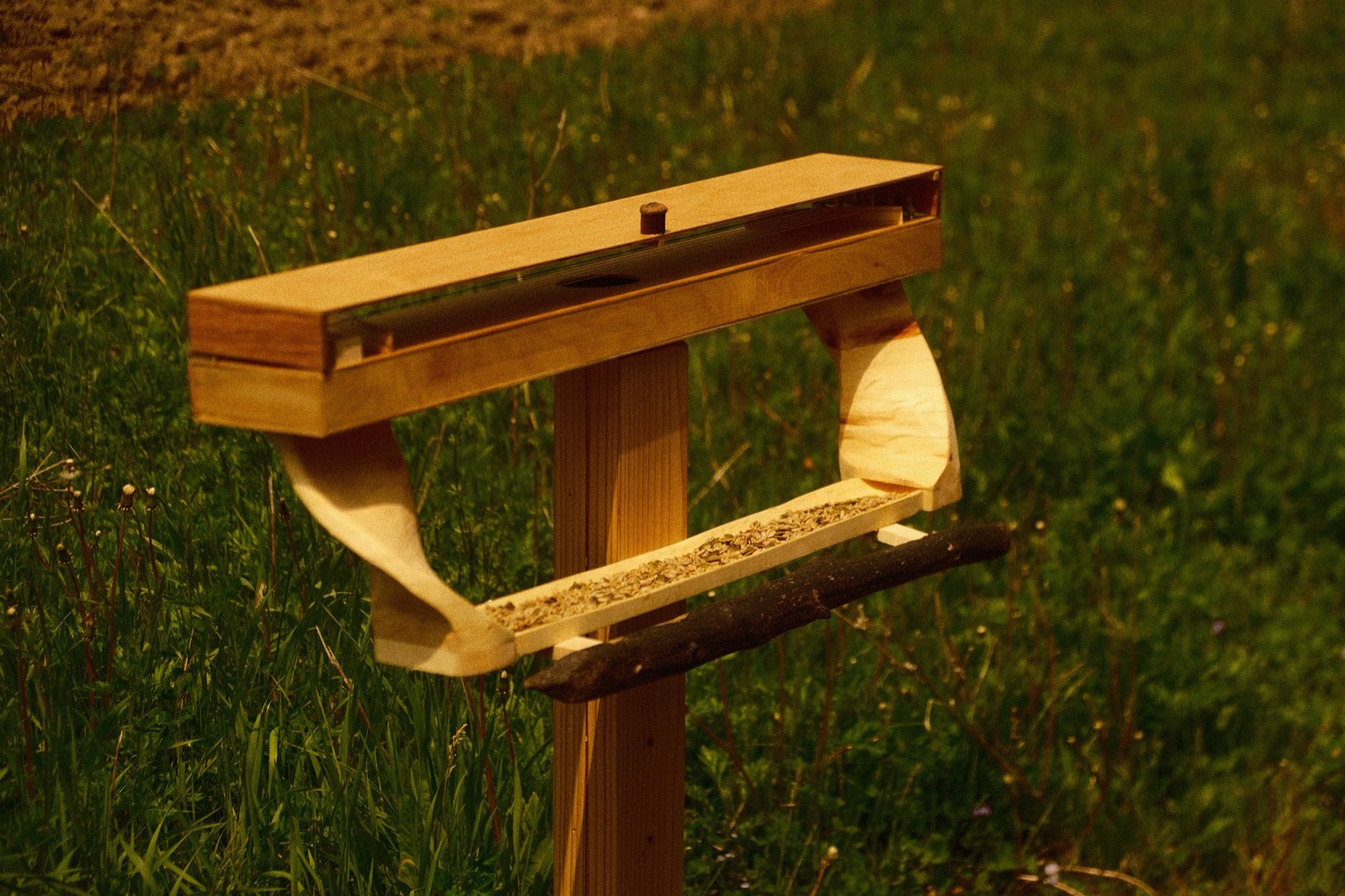
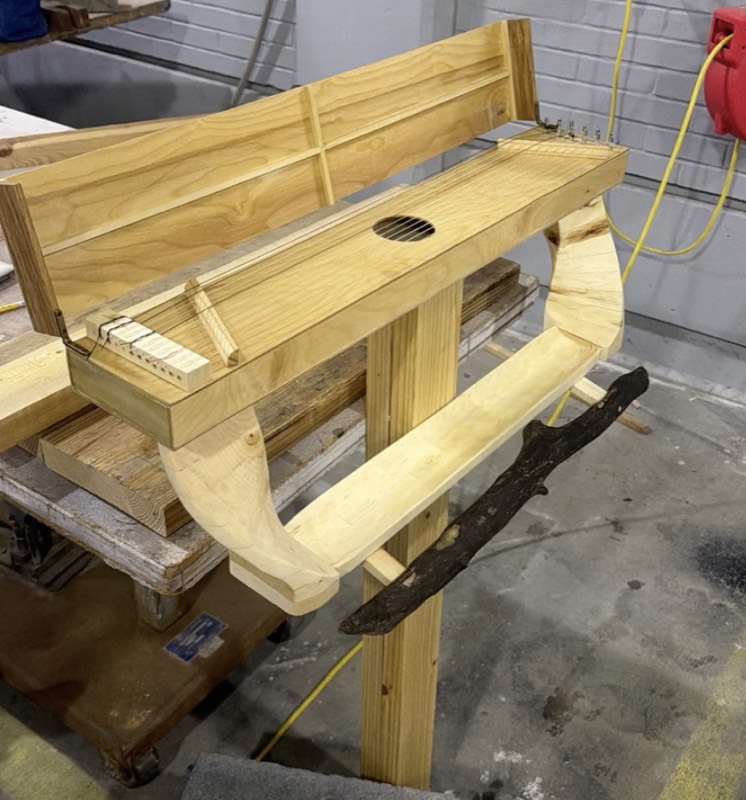
The harp, feeder, natural perch and mounting structure were fabricated as one physical sculpture.
02
The sculpture, in the round
A reconstruction of the finished piece. Turn it, open the lid, or look closely at a part.
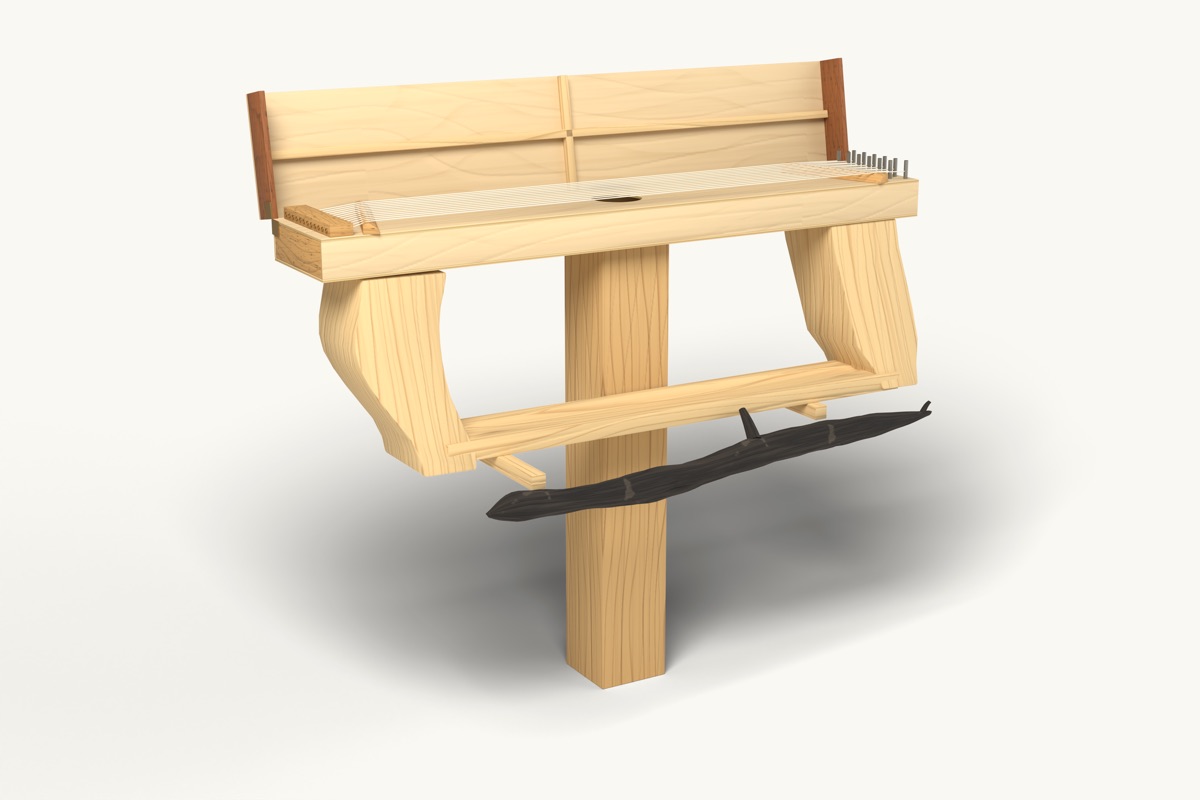
- Source-dimensioned
- Photo-reconstructed
- Artist-confirmed
03
Played by wind
Twelve nylon strings run the length of a 76 cm soundbox. Closed, the lid leaves a narrow slot, and wind crossing it sets the strings moving.
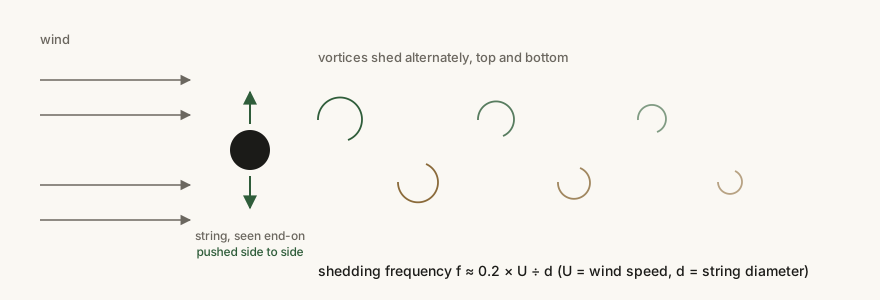
Air passing a string sheds small vortices from alternate sides, nudging it back and forth. When that rhythm meets one of the string’s natural frequencies, it rings — usually on an overtone, which shifts as the wind changes.
- Strings
- 12 nylon, 57–65 cm long
- Soundbox
- 76 × 13 cm, birch plywood
- Wind slot
- about 4 cm, lid closed
04
Listening to the Black-capped Chickadee
The sculpture began with a question: why do we treat music as ours alone?
I built it around the Black-capped Chickadee, a year-round neighbour in the Hudson Valley whose songs and calls carry information of their own, and used its acoustic communication as a design input for an instrument played by wind rather than by a performer. Its sounds sit in several frequency regions — there is no single “chickadee frequency.”
I tuned the strings for the chickadee rather than for human ears, as my artist statement recorded at the time. Their base pitches sit far below the birds’ range, but their overtones reach up toward it. The exact values weren’t kept, so no tuning map is claimed.
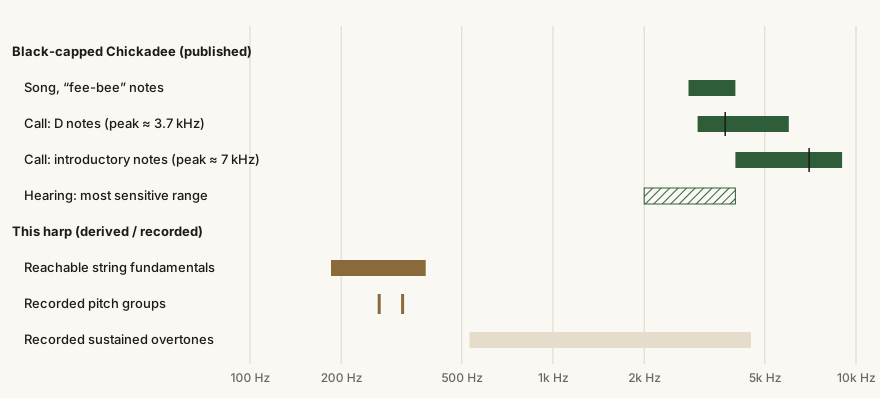
Ranges and sources
- Song (“fee-bee”): two nearly pure notes around 3–4 kHz, with a closely kept pitch ratio between them.
- Chick-a-dee call: introductory notes peak near 7 kHz; D notes near 3.7 kHz.
- Hearing: most sensitive between 2 and 4 kHz.
Foote et al., Birds of the World (2020); Weisman & Ratcliffe, American Scientist 92 (2004); Courter et al., PLoS ONE 15 (2020); Proppe et al., PLoS ONE 6 (2011); Wong & Gall, Zoology 118 (2015); Templeton, Greene & Davis, Science 308 (2005). Aeolian physics: Jenkins, Physics Reports 525 (2013).
05
The finished harp in the field
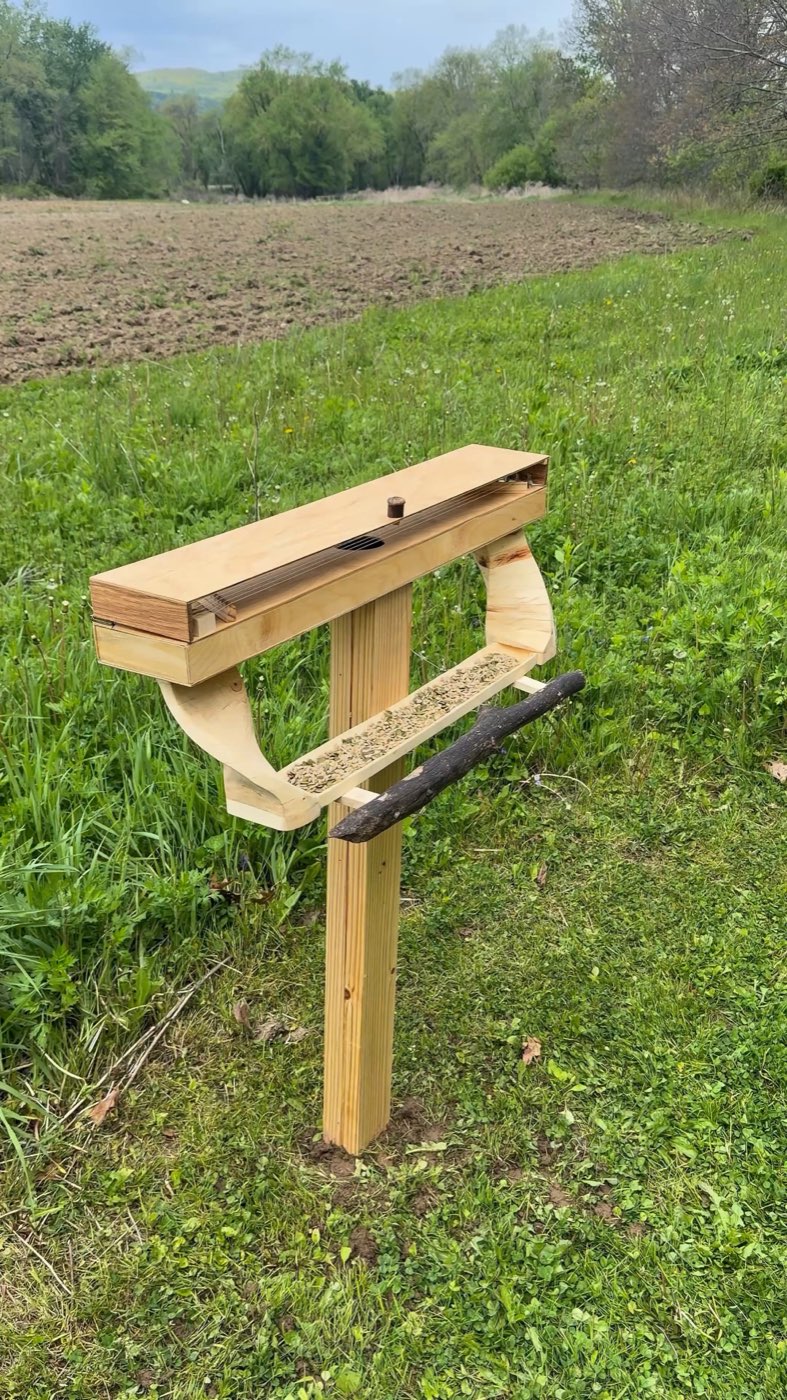
The measurement follows the sound. Observations appear as the recording reaches them.

Reading the measurement
Top: loudness of the recording. Below: the spectrogram measured from it — time left to right, frequency bottom to top on a linear scale from 150 Hz to 4.6 kHz; darker means louder, relative to the loudest moment in the clip. Ticks on the right edge mark the harmonics of the two published pitch groups: about 267 Hz (short, green) and about 319 Hz (long, brown).
All four observations
- 0 sFrom the start: the two sustained pitch groups, about 267 Hz and 319 Hz. Ticks on the right edge mark their published harmonics.
- ≈ 2.6 sFrom about 2.6 s: upper harmonics between 2.5 and 3.5 kHz build up.
- ≈ 4.7 sFrom about 4.7 s: the band near 1.6 kHz — the 5th harmonic of the 319 Hz group — swells by about 30 dB.
- ≈ 9.0 sNear 9 s: energy close to 745 Hz peaks. It is not a harmonic of either group.
Average spectrum, full clip (published figure)
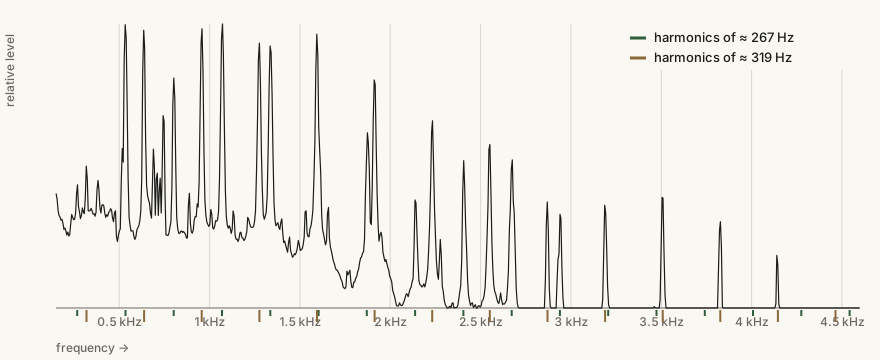
- ≈ 267 Hz
- sustained pitch group
- ≈ 319 Hz
- sustained pitch group
- to ≈ 4.5 kHz
- harmonics above them
Several strings ring together in each group, and their harmonics carry much of the sound. Wind sits underneath, mostly below 400 Hz.
Short-time Fourier analysis of this recording (Hann window, 30 frames per second, levels relative to the loudest moment). An observation’s time is where a band’s level first stays at least 6 dB above its opening level for a second, smoothed over ±0.5 s, so times are approximate. Not everything belongs to the two groups: of the 20 strongest peaks in the average spectrum, 15 sit on a harmonic of 267 Hz or 319 Hz; peaks near 480, 690, 745, 890 and 1,660 Hz do not, and the published figure shows the same.
These measurements describe the recorded finished harp, not the unrecovered original target tuning.
This shows the sound the finished harp produced in the field. It does not show or test how chickadees hear or respond.
06
Reconstructing it
The harp body is source-dimensioned; the custom feeder, perch and mounting structure were reconstructed from fabrication and installation photographs.
The model was checked against cameras matched to the original photos, and every part carries its evidence status in the 3D file.
Harp body adapted from a published DIY Aeolian harp design (Metal Marshmallow, 2023). The feeder, natural perch, mounting system, species study, tuning approach and installation were developed for this sculpture.
07
In place
The research didn’t pass cleanly into the object. Wood, wind and my own hands reshaped it at every step, and the slow work of making it became part of what it meant.
“I chose the frequency. I built the structure. I decided what the bird needed.”
From my artist statement, 2026